
Kind Voice and the Path Toward More Secure Attachment
Last week** was the start of Module 3 and the sixth of twelve live meetings for the Professional Certificate in Brain Health Program teaching the 9 Skills of the Wizard Brain (technically known as the 9 Functions of the Prefrontal Cortex in interpersonal neurobiology).
**Since this post was written, the first program has finished. A new cohort is currently being formed.
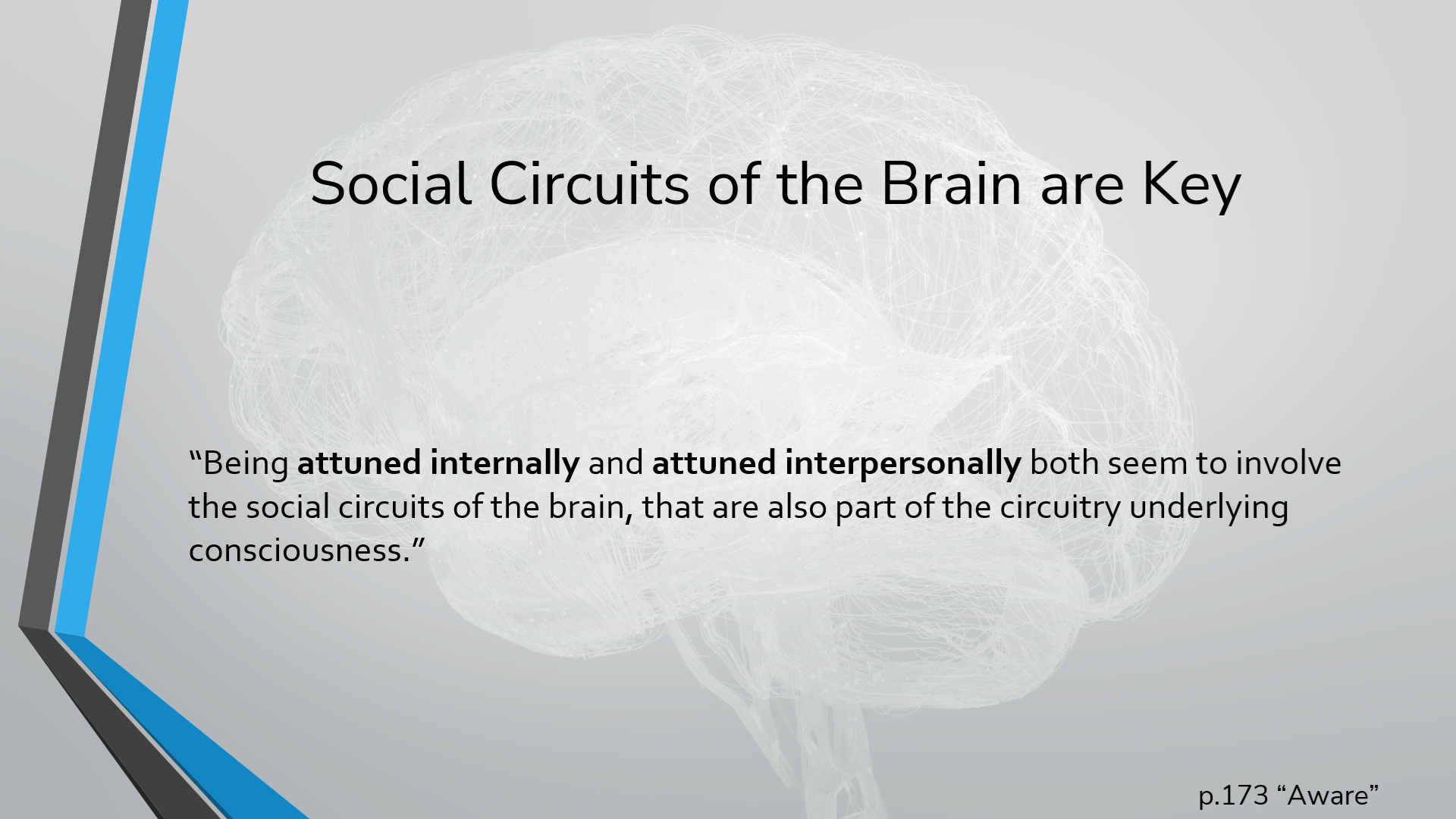
I started the class with this slide
And the class content was so revolutionary that I decided to make a blog post about it.
One teaching point in the program is learning a technique that I developed called “kind voice” and this was the second class going into deeper explanations about the technique.
For a short description that overviews what the technique is, I would say that you practice self-compassion and talk to yourself as if you are your own best friend, and the brain health coach learns to coach the client in doing this together in a session.
This class was on the 3 Levels of Kind Voice:
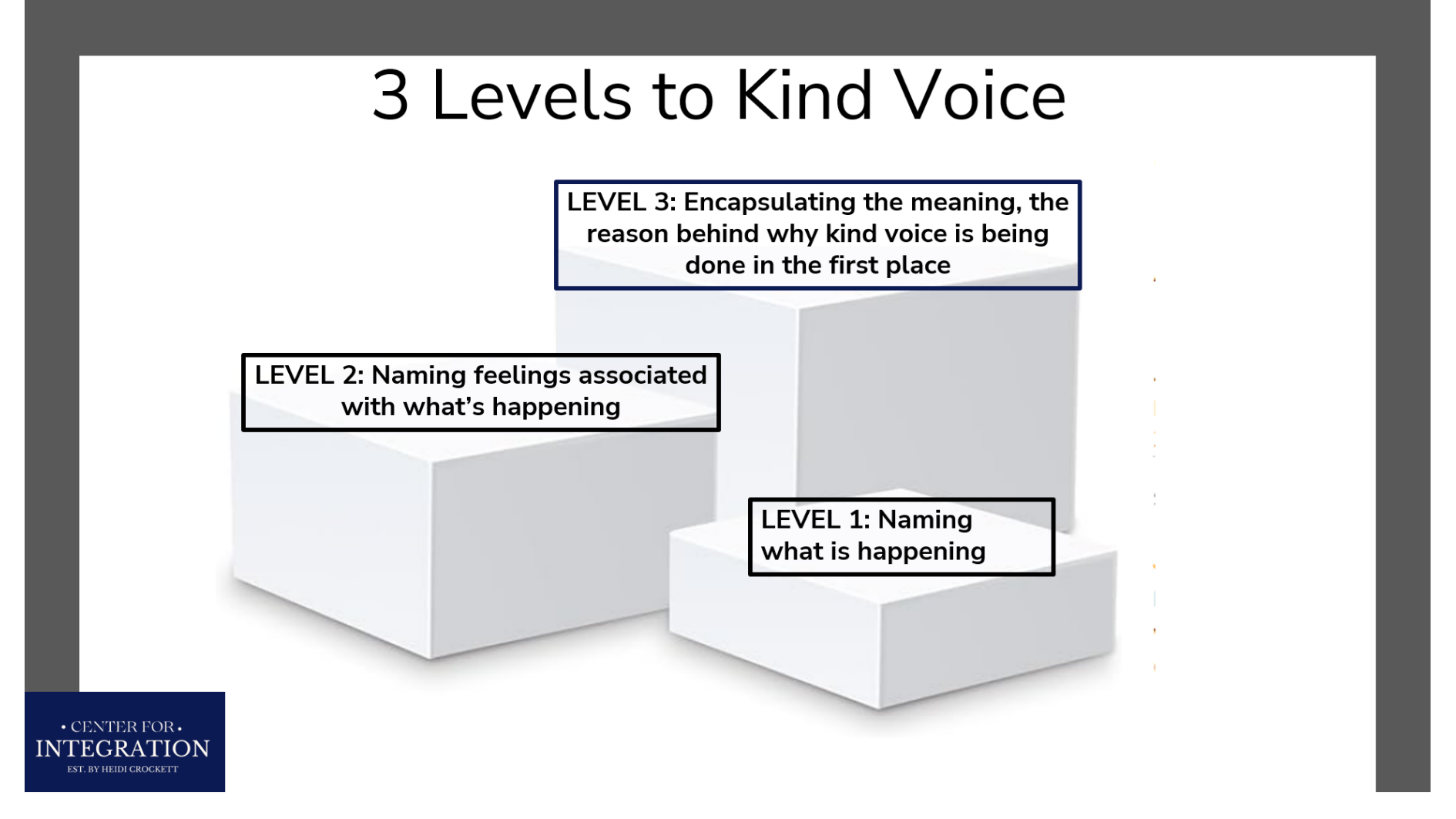
And I needed to explain a bit more to students about what changes we are aiming to support (in the client’s brain) when we practice kind voice, so they could understand how to modify the technique between the 3 levels.
What we are doing with Kind Voice Technique is helping the brain move toward its evolutionary birthright of successful coregulation and a strong wizard brain (prefrontal cortex). These capacities may support more secure patterns of attachment and relating.
The class went into some fundamental “glitches” that happen in adults when they are upset about something and can sometimes involve an actual or perceived “relationship rupture,” using attachment lingo.
(Get ready for the complication level to explode in this blog post.)
In order for students to understand what we are doing I needed to bring in some information about the 7th and 8th Levels (“Domains”).
To start, within the 9 Levels teaching framework, the 8th Level is the highest level and one of the hardest functions for the brain to achieve – it is called Time Integration. It is the brain being able to make sense of the passing of time and hold states of uncertainty (called here the pain of living) while also being in certainty.
[Side comment: There is a “9th Level” after the 8th Level but it is about integrating all 8 Levels more deeply and fully, so the 8th is the last unique skill to understand and better integrate.]
Here is a slide from the class on the 8th Level:
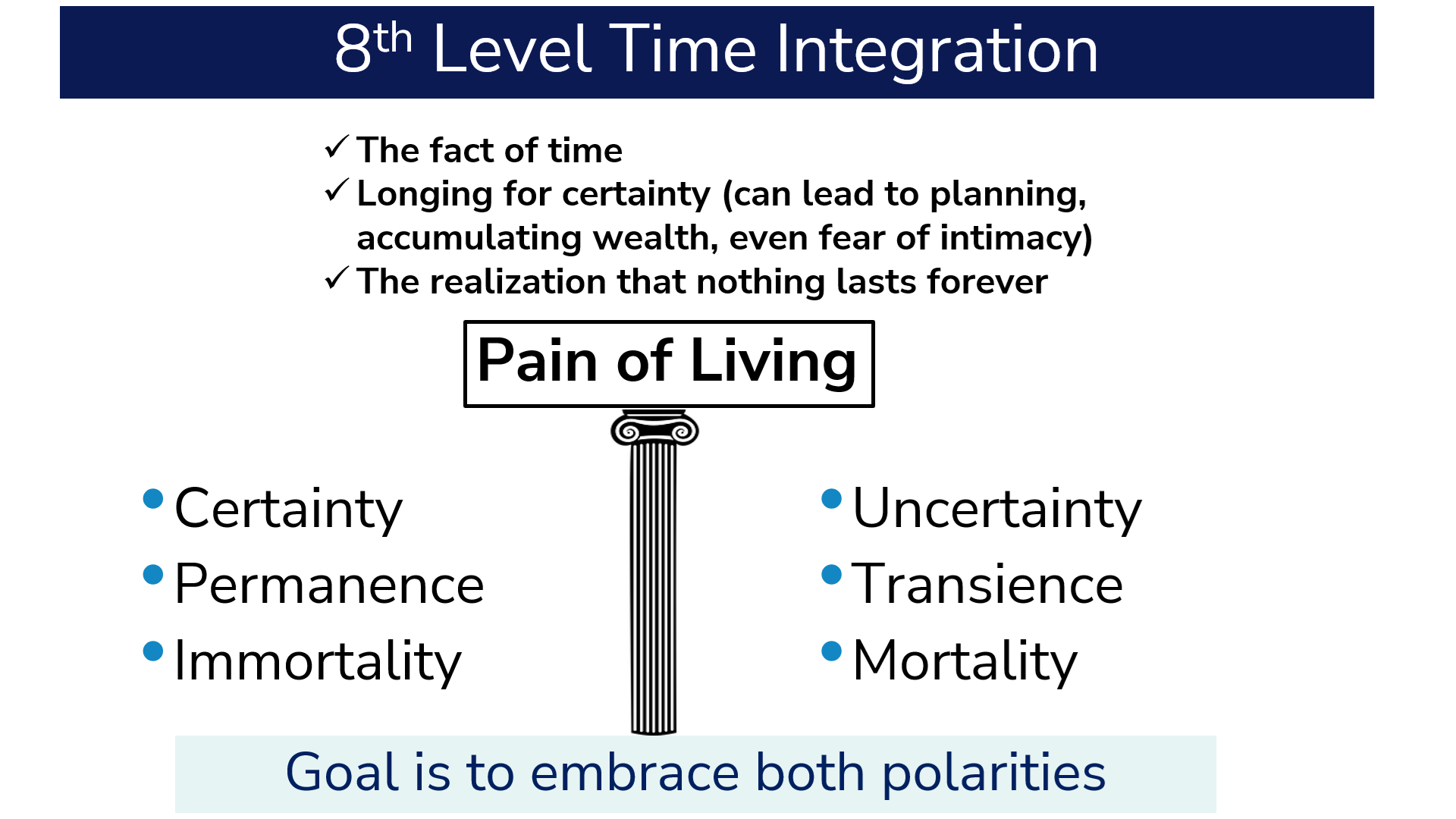
When an upsetting rupture happens (referred to here as the “pain of living,”) it requires the skill of the 8th Level which is to make sense of the loss and to move forward purposefully in life. Loss examples are when a beloved pet dies, or a friend disappears suddenly, or a job or career.
When there isn’t good “integration” in the thinking—to integrate means to differentiate (separate) and link with the goldilocks “just right” amount of each one—then rigidity and/or chaos result when trying to process this loss.
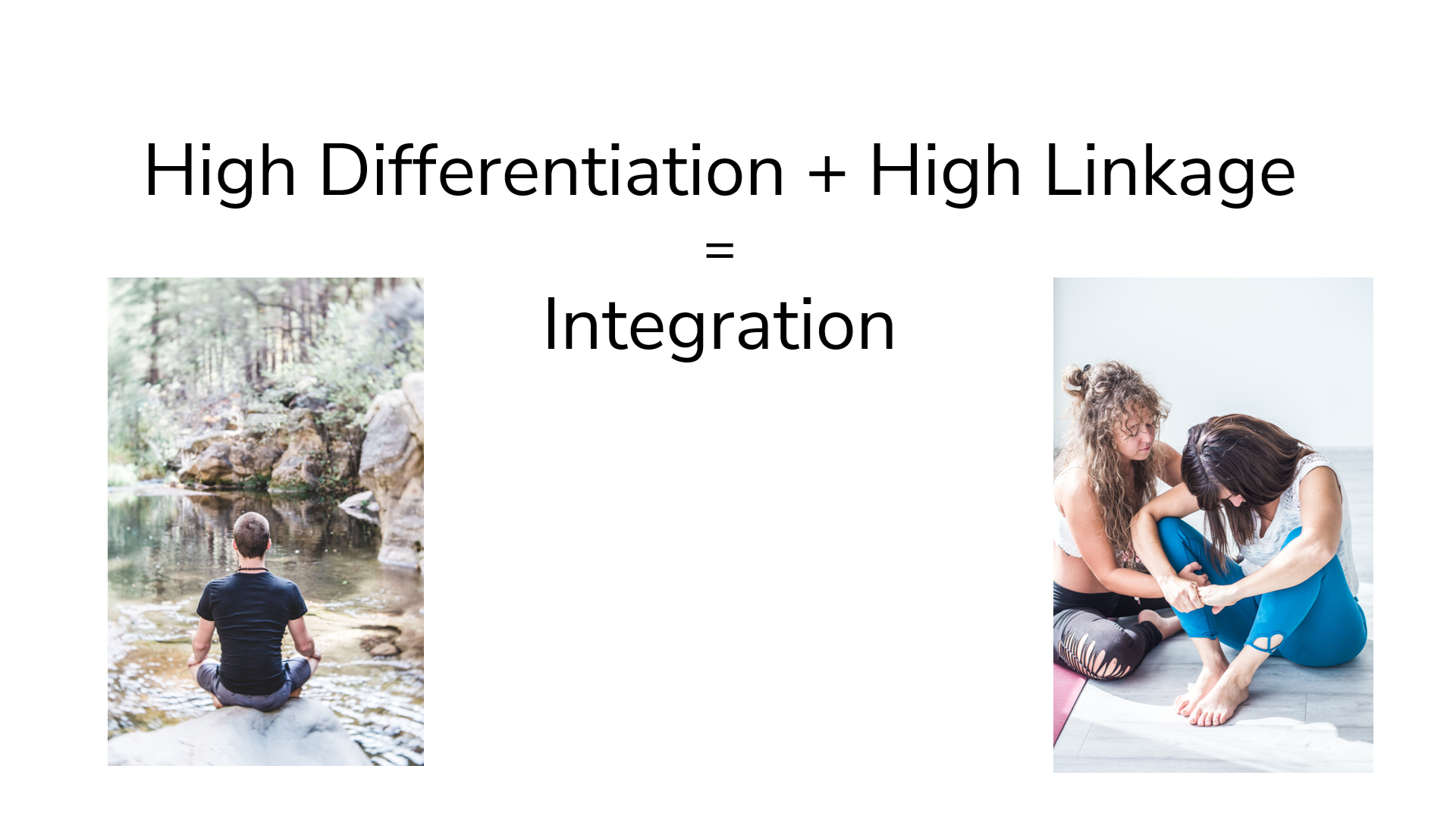
The 8th Level explores a tension between the part of us that wants certainty and resists change and mortality, and the part that can recognize uncertainty, mentally travel through time, and understand that our lives will eventually end.
When these two ways of experiencing life aren’t adequately differentiated and linked, we call that a “lack of integration” at the 8th Level.
What this means is that we may have difficulty differentiating from the part of the brain that wants everything to remain the same and is afraid of uncertainty. We may also have difficulty linking with our capacity to tolerate uncertainty and change. (Super nerd moment: sometimes the pain of living can be thought of more specifically as existential aloneness and death anxiety.) That would represent the 8th Level being unintegrated or lacking enough integration.
So the rest of this blog post will be the main point that I was wanting to communicate here but I had to take some time to outline some concepts.
Within this teaching framework, the levels are progressive, so difficulties integrating experiences described at the 7th Level may also affect capacities described at the 8th Level.
What this translates into is when you are sad about the relationship rupture of your job, losing your income, your coworkers, and your identity that came with that job (yes every loss contains many losses in it, many “relationship ruptures” in it,) your ability to successfully navigate that pain of living and make meaning and move on will relate to your story about rupture from childhood, (which is called your attachment style, called "Child Brain" in the below slide).
This is different than your attachment process which is the part of your brain that relationship ruptures and relationship repairs every day, (called “Adult Brain” in the below slide).
The 7th Level is about achieving a secure attachment, it means the capacity to have your own identity while also being in caring relationships with others:
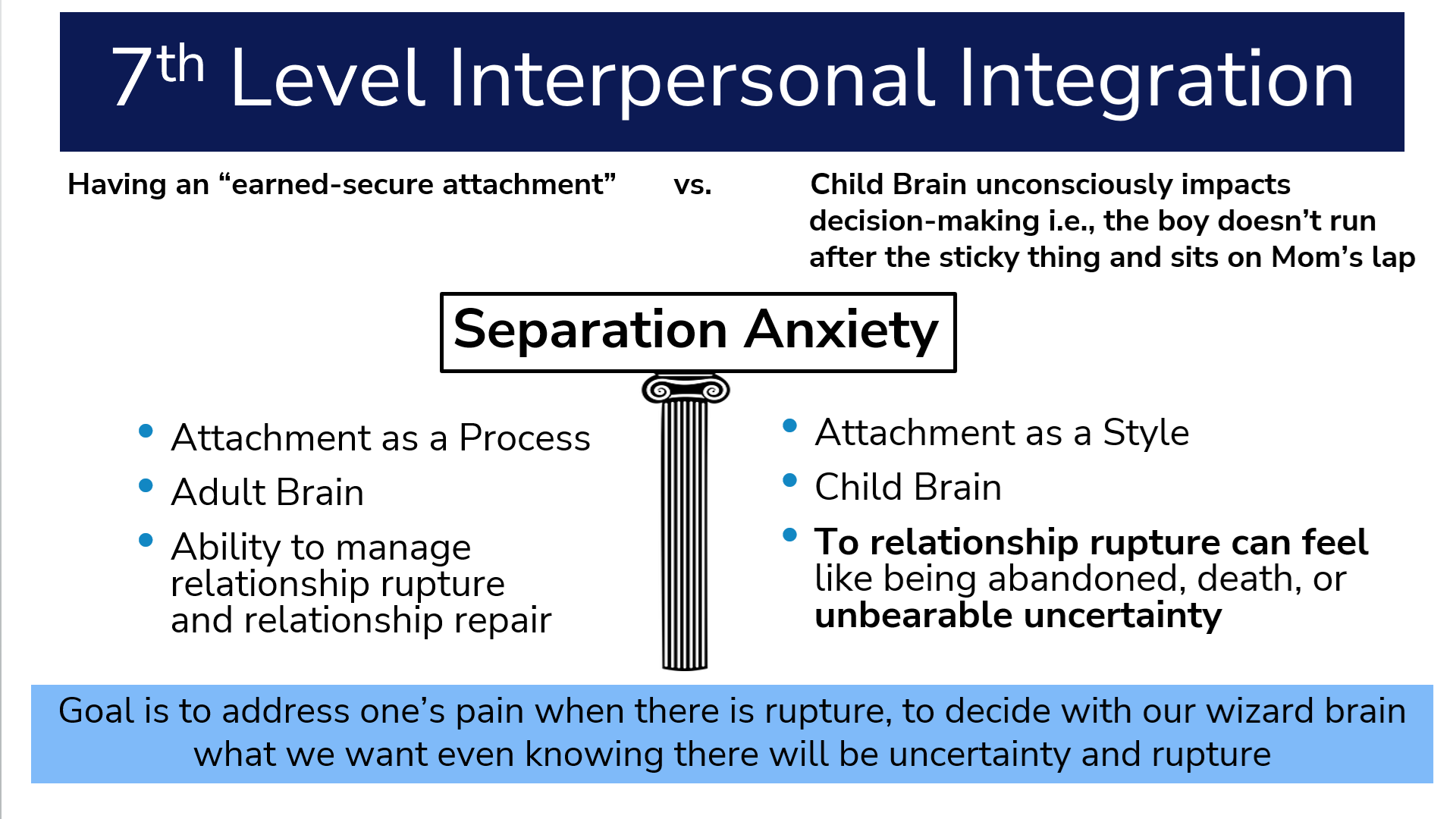
What can happen around a loss is that the brain’s “synaptic shadows” from earlier experiences may layer stories of separation anxiety and insecure attachment onto a relationship rupture happening in present-day time.
In summary, like a hall of mirrors, separation anxiety and the pain of living get mixed up because they haven’t been differentiated and linked (integrated) optimally.

It starts in childhood...

"Child Brain" is a nickname for our attachment style -- Attachment is "an internal working model of security" we developed growing up from our primary caregivers

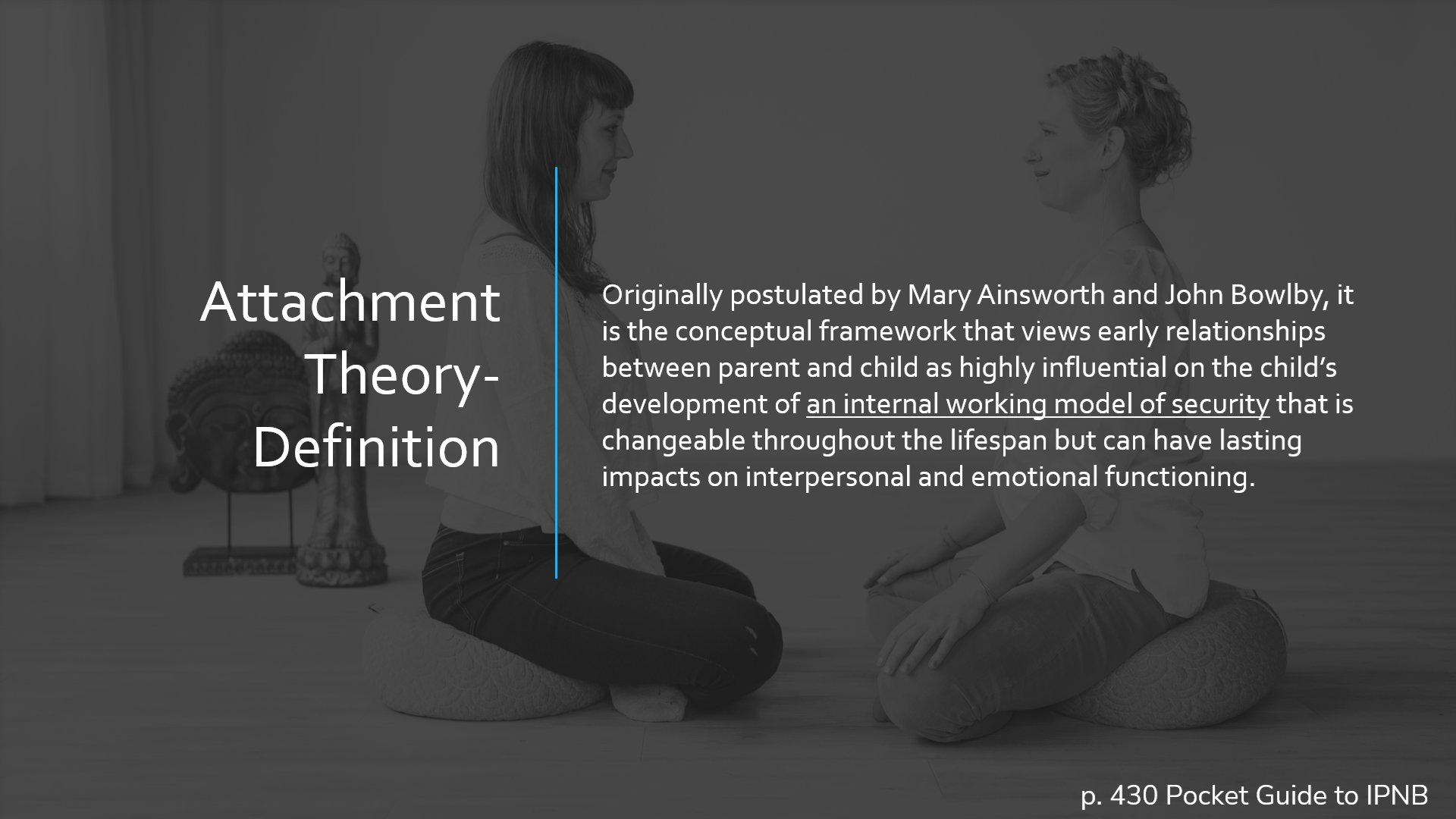
Then we continue to manage relationship rupture and repair throughout our lives:

This is the part of us that is attaching throughout our lifespan, called Attachment as a Process and "Adult Brain":

It's normal for our awareness to go back and forth between these two and integrating at the 7th Level means growing an awareness of the Adult Brain and the Child Brain.

The content is too much to explain in a blog post but the general idea in this teaching framework is that when we do Kind Voice with clients, we are practicing differentiation and linkage between the capacities described in the 7th and 8th Levels. 
I’ve included slides from the class but the main purpose of this blog post is to attempt to outline a core tenet of my Professional Certificate in Brain Health, which fascinates me the most about our brains: How social circuitry is crucial to the development and integration of the brain (and how Kind Voice aims to support these underlying capacities) to improve your overall well-being.


Below is the "Kind Voice Technique" flashcard which summarizes what this blog post discusses in greater detail. (NOTE: I do have a 6+ hour workshop "Kind Voice: The Extended Version" if you want to learn about the technique and the science explained in this blog post.)
Front Side of Flashcard

Back Side of Flashcard:

(Want to learn more about the flashcards? See my newer blog post on them here. )
-------
In conclusion, I’ll paste what is in the video description for this class #6 of 12 of the 9 Wizard Skills Program:
AN OVERVIEW OF THE CLASS
Heidi will explain the 3 levels of kind voice, what kind voice is and why we do it, and many other concepts you’ll want to know to be an effective brain health expert– there is a lot on attachment, what it is and what to do when you want to support more secure patterns of attachment in yourself and your clients.
This Module 3 class could be titled “Everything essential you need to know about interpersonal neurobiology, self-compassion research, the science on shame and attachment, and how to help integrate trauma / big relationship rupture.”
(And this specific class is included as part of the Kind Voice: The Extended Version" Workshop.)
---------------------------------------------------------------
And now I'll finish this blog post stating that I couldn’t be more pleased with the first cohort in our brain health program this semester. One student wrote “The lessons are so interesting and inspiring to learn! I look forward to the next session on Thursday." LS
------> The 9 Levels of Neural Integration were taught in the following semester, with greater focus on the 7th and 8th Levels than in the executive function semester.
Are you interested in joining the Center’s next Professional Certificate in Brain Health? Click here to learn more about the 9 Levels.
